When we talk about screen printing, the conversation usually centers on the stencil, the ink, or the paste. Yet there's a quiet hero that's constantly in your hand (or your machine) during printing: the squeegee rubber. A well-chosen squeegee sharpens your print, cuts ink waste, and extends the life of your stencil. A poorly chosen one can be the silent culprit behind questions like "why did the print come out so thick?" or "why are the fine lines breaking up?"
In this article, we cover what to watch for when choosing a squeegee, what hardness values actually mean, and how to extend your rubber's lifespan.
What Does a Squeegee Actually Do?
A squeegee may look like it does one job, but it actually handles four tasks at once:
- It pushes ink (or paste) through the stencil openings onto the printing surface.
- It scrapes off the excess ink left on the stencil.
- It maintains even line contact between the stencil and the printing surface.
- It makes it possible to print on surfaces of different shapes and structures.
A quality print requires all four tasks to be done well — and what determines that is the squeegee's physical properties. So choosing a squeegee isn't just about "making it durable"; it means thinking about what job you're doing, on what surface, with what ink.
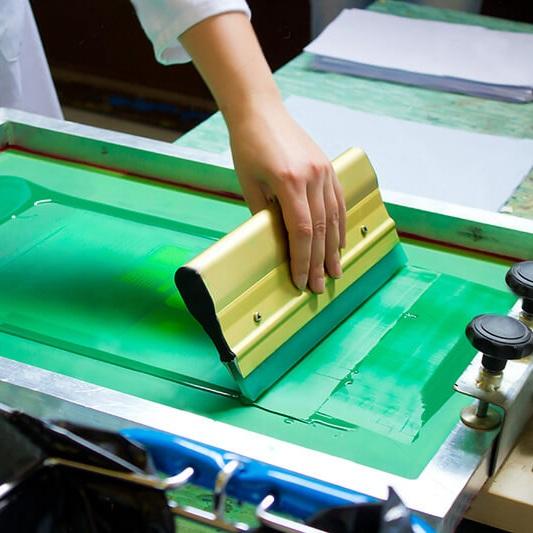
Hardness (Shore) Selection: The Most Important Decision
The most critical property of a squeegee is its hardness, expressed as a shore (A) value. Roughly, we can divide them into three groups:
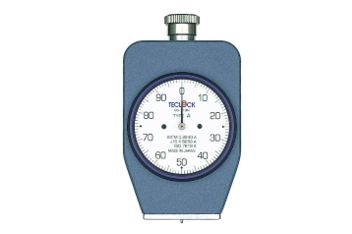
Soft Squeegee (about 45A–65A)
Suitable for low-viscosity (free-flowing) inks, irregularly shaped objects, and rough surfaces. As hardness drops, the ink layer deposited on the surface gets thicker; in return, print fineness stays moderate. That's why it's preferred for large-area color prints and applications like glass and ceramics.
Medium-Hardness Squeegee (about 70A–75A)
The "do-it-all" middle ground. 75A in particular is the most widely used value. It works with most mesh and ink types, delivers both good ink deposit and high resolution, and can be used across different materials. When you're unsure, starting here is generally a safe choice.
Hard Squeegee (about 80A–95A)
Used for high printing pressure and high-viscosity (thick/dense) inks. Ink deposit is low and resolution is high — making it ideal for prints requiring fine detail. It also scrapes excess ink off the stencil very well. But there's a trade-off: it adapts less well than softer squeegees to differently shaped or uneven surfaces.
Quick summary:
| Soft (45A–65A) | Medium (70A–75A) | Hard (80A–95A) | |
|---|---|---|---|
| Ink layer | Thick | Balanced | Thin |
| Resolution / detail | Moderate | High | Very high |
| Conforming to surface | Very good (uneven surfaces) | Good | Limited |
| Typical use | Glass, ceramics, large-area color prints | General-purpose, most common (75A) | Fine detail, high-viscosity ink |
Mind the Blade Edge: Small Detail, Big Difference
The blade edge of the squeegee — the edge that touches the surface — is decisive in how well all four tasks work. Its sharpness directly affects how much ink is deposited at the start of printing:
- Sharp blade edge: Deposits minimal ink and delivers fine patterns cleanly.
- Blunt or rounded blade edge: Increases the amount of ink deposited; color and line fineness are affected too.
So if your lines start thickening or your color tone starts shifting, before blaming the rubber itself, it's worth checking whether the blade edge has worn down.
What to Check When Buying
When buying a squeegee, we recommend these simple checks:
- Its appearance should be neat and clean
- The surface should be smooth, with no impurities or air bubbles
- The blade edge should be flat and smooth
- It should have good elasticity and toughness
Ways to Extend Your Rubber's Life
Don't leave it sitting in ink or solvent when not in use. The longer the rubber sits there, the more it's exposed to solvent and ink, and the faster it breaks down.
If you're working with solvent-based inks, keep 2–3 sets of squeegees. Rotating them on following days gives each set time to rest and extends overall service life.
Clean thoroughly after use. No ink or thinner residue should remain on the rubber. After cleaning, dry it with a soft, water-absorbing cloth and store it flat.
Reconditioning: Don't Rush It
Right after cleaning, the rubber is still soft because the solvent hasn't fully evaporated. So don't regrind it immediately after cleaning. Letting the rubber rest for 12–24 hours before regrinding improves both the grinding result and the print result. During regrinding, try to remove as little material as possible — that way you can regrind and reuse the same rubber many times.
Storage
If you're storing it for a long time:
- Package it well. Keep it away from direct sunlight or any UV-containing light — otherwise aging accelerates.
- Store it flat if possible.
- If you have to roll it up, roll it in the reverse direction (against the rubber's natural curve).
Summary: Quick Checklist
- Uneven surface, or glass/ceramic? → Soft squeegee
- General-purpose, not sure? → Start with Medium (75A)
- Fine detail, dense ink? → Hard squeegee
- Lines thickening, color shifting? → Check the blade edge
- Working with solvent-based ink? → Rotate 2–3 sets
- Reconditioning? → Wait 12–24 hours after cleaning
- Storage? → Flat, away from sunlight
Squeegee Rubber at UES
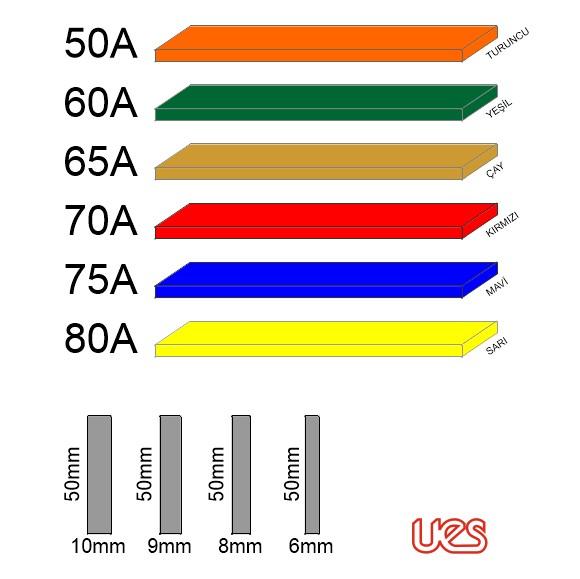
At UES, we offer imported polyurethane (PU) squeegee rubber in 3.66-meter rolls, 50 mm width, 10-9-8-6 mm thicknesses, and a 50A–80A shore hardness range. Our imported PU squeegees offer top-level chemical resistance — a good choice for anyone looking for a product that stands up to cracking and swelling, the most common problems with squeegee rubber.
Rectangular
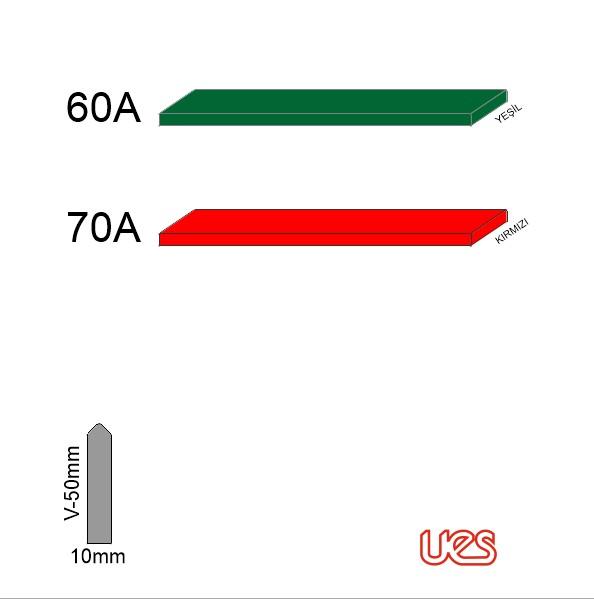
"V" Tip
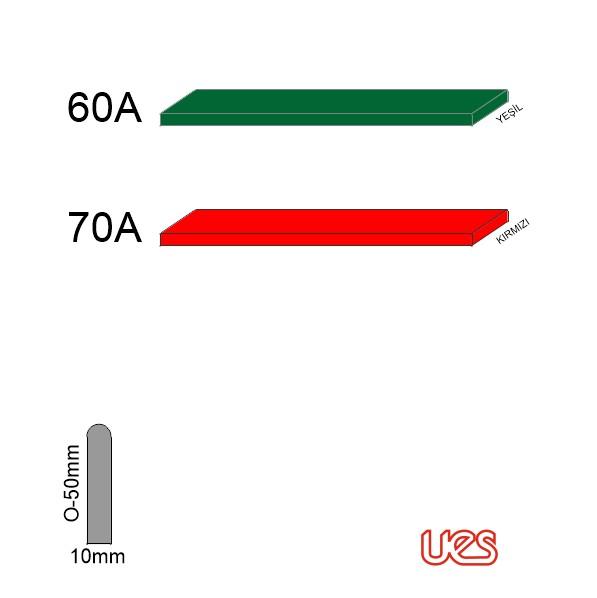
"O" Tip
How do you choose squeegee blade hardness (shore A)?
For uneven surfaces or glass and ceramic, a soft squeegee (about 45A–65A) is preferred; for general-purpose work, a medium-hardness squeegee (70A–75A); for fine detail and thick, high-viscosity inks, a hard squeegee (80A–95A). If you are unsure, starting with 75A is a safe choice.
What is the most commonly used squeegee hardness in screen printing?
The most commonly used value is 75A. It works with most mesh and ink types and delivers good ink deposit together with high resolution.
What should you check if print lines get thicker and the color shifts?
First check whether the blade edge of the squeegee has worn down. A sharp edge transfers a minimum of ink and gives crisp fine patterns; a dull or rounded edge increases the amount of ink transferred.
How can the life of a squeegee blade be extended?
Do not leave it sitting in ink or solvent when not in use, clean it thoroughly after use, dry it with a soft absorbent cloth and store it flat. If you work with solvent-based inks, rotating 2–3 sets of squeegees extends their total service life.
Can a squeegee blade be sharpened right after cleaning?
No. Right after cleaning, the rubber is still soft because the solvent has not fully evaporated. Letting the blade rest for 12–24 hours before sharpening improves both the sharpening result and the print result.
How should a squeegee blade be stored for a long time?
Package it well, keep it away from direct sunlight and UV-containing light, and store it flat if possible. If you have to coil it, coil it in the opposite direction, against the rubber's natural curl.
Which squeegee blades does UES offer?
UES offers imported polyurethane (PU) squeegee blades in 3.66-meter rolls, 50 mm wide, in 10-9-8-6 mm thicknesses and a 50A–80A shore hardness range. Rectangular profile, "V" edge and "O" edge options are available.
If you're not sure which hardness fits your printing type and ink, reach out via our Contact page — let's make the right choice together .